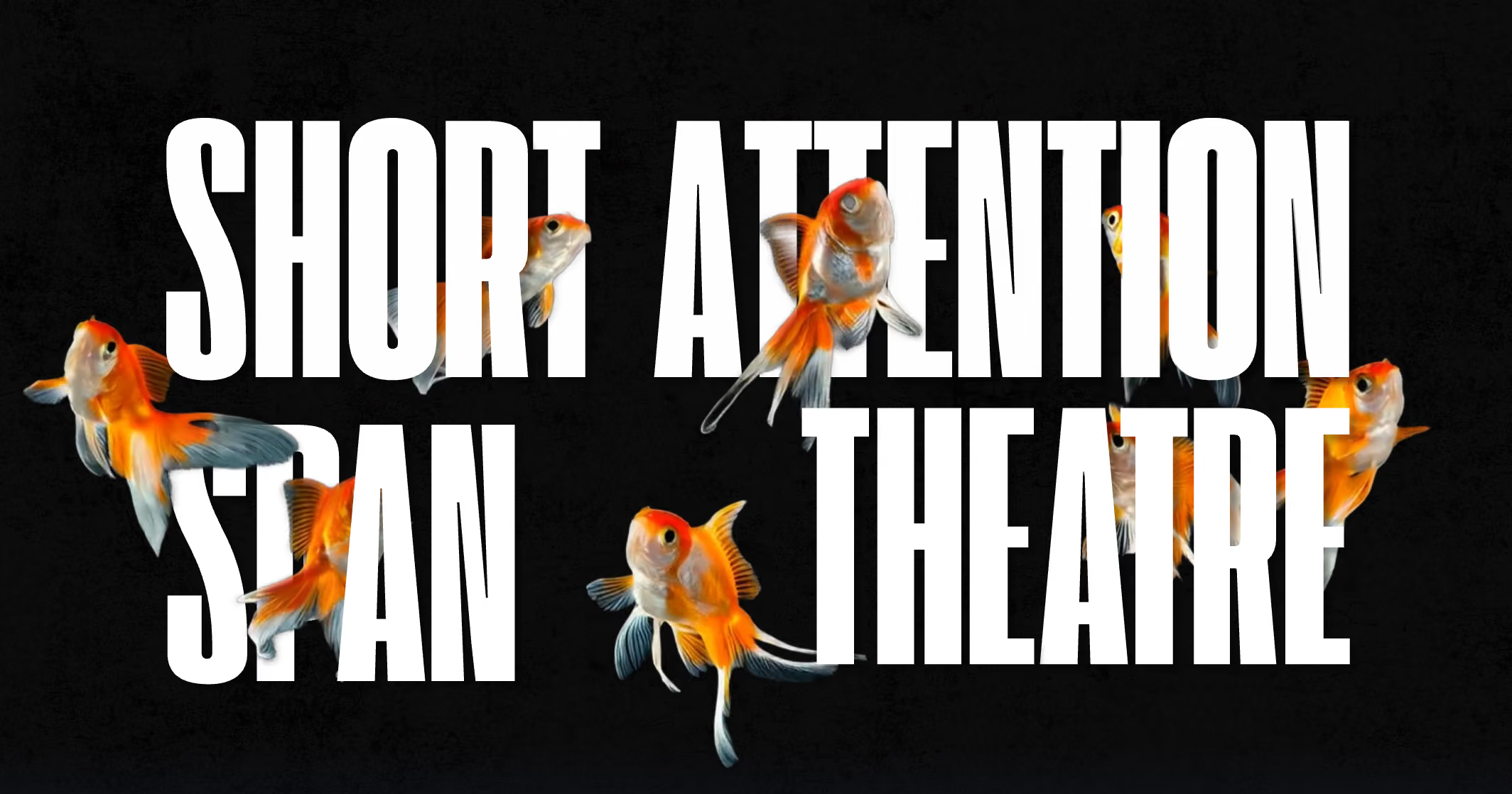
A few weeks ago, our team took the stage at Experiential Marketing Summit for a two-hour workshop called Short Attention Span Theatre. And yes, the irony of holding a two-hour session about shrinking attention spans was very much intentional. We leaned into it.
The whole thing was built around a simple premise: in a world where you have seconds (not minutes) to earn attention, the answer isn't bigger. It's sharper, faster, and smarter. So instead of delivering a lecture about that idea, we tried to live it — a fast-moving series of micro-sessions that each modeled exactly what they were teaching.
What kept a room full of conference-goers locked in for the full two hours wasn't production value. It was people sharing things they actually know, from places they actually live.
🧠 Session One: The Science of Attention
Michael Dezso, our Head of Experiential Strategy, opened with a reality check: attention is older than consciousness. It evolved as a survival mechanism — a biological reflex that responds to movement, contrast, emotion, and anomaly before your conscious brain has even weighed in. Your audience isn't being rude when they ignore you. Their nervous system is doing exactly what 300,000 years of evolution designed it to do.
The implications for experience design are significant. Stillness is invisible. Repetition gets erased. Consistency, as Michael put it, is paradoxically the fastest path to being ignored. Your brain doesn't just overlook static stimuli — it actively deletes them to preserve bandwidth for anything new. (This is a real phenomenon called Troxler Fading, and once you know it exists, you will never design a static booth again.)
Troxler FadingThe session closed on Las Vegas as the greatest attention engineering lab on earth, a place where every lighting choice, layout decision, and yes, carpet pattern is a direct translation of neuroscience into architecture. Vegas isn't overstimulating. It's precisely stimulating. There's a difference, and it's worth about $7 billion a year on the Strip alone.
🐿️ Session Two: Designing for Distraction
Joneric Amundson, our Executive Creative Director, came in with five tactical principles for breaking the script in crowded spaces, and a conviction that people aren't apathetic. They're on guard.
His framework: reduce friction, increase intrigue, reward quickly. The five moves that get you there are pattern interrupts that make sense, action before explanation, visible payoff, low commitment with high curiosity, and curiosity gaps. Each one came paired with a real-world example — from the adidas Liquid Billboard to the TNT "Push to Add Drama" button to Fearless Girl on Wall Street.
adidas Liquid BillboardThe throughline: don't invent new formats. Corrupt existing ones. The best pattern interrupts use familiar structures with unexpected behavior. And if someone can't understand what to do from 15 feet away in under two seconds, you've already lost them.
🧑🎨 👨🎨 Session Three: Co-Create or Fade Out
Caroline Lee, one of our senior strategists, is a bonafide Dungeon Master (yep, that's a role in D&D for the uninitiated). She unpacked the science of storytelling through the mechanics of the game...and it landed exactly the way you'd hope.
Storytelling is a waltz.The core argument: storytelling is a waltz, and an experience with only one dancer is an experience with half its power. Audiences aren't passive recipients of your narrative. They're co-authors. The experiences that stick aren't the ones that deliver a story perfectly. They're the ones that give people the tools to invent their own.
She drew a distinction between branching narrative (choices within a structure you control) and emergent narrative (handing people the keys and letting them actually drive). The most memorable activations live in the second category. People don't remember your story. They remember theirs.
Five truths structured the session: challenge your definition of story, design for meaning-making not exposure, honor your audience's time like currency, romanticize the details until they become portals, and always leave room at the table for the unknown.
💿 Session Four: Keep Them on the Floor
Kiré Davis, senior strategist and acclaimed DJ, used the dance floor as a framework for reading a room in real time. The concept: attention cycles through four states (focused, rote, bored, frustrated), and the designer's job isn't to hold someone in one state indefinitely. It's to move them through the right states in the right sequence...just like a DJ does.
The original experiential marketer.The DJ framework extended further: mixing in key (coherent emotional sequencing), phrasing (structure carries the story), and mashups (familiar hook, unfamiliar foundation). The final provocation from him was maybe the most useful thing anyone said all day: Stop measuring the room. Start reading it.
🪄 The Magic
What made this workshop different (besides the top tier content)? None of it was delivered through jargon, case study carousels, or "here's a framework" energy. It came through a D&D campaign. A Saturday night DJ set. The actual science of what your brain is doing while you're reading this sentence. The speakers didn't just talk about how to hold attention. They held it...by showing up as full people with real obsessions, and letting those obsessions do the teaching. Which, if you were paying attention, was the whole point.
4 Takeaways Worth Your Undivided Attention 👀
1. Design for the reflex, not the rational. Attention is a biological response, not a conscious choice. Movement, contrast, emotion, and anomaly will always win over a well-crafted message that asks the brain to slow down first.
2. Explanation is friction. The fastest path to engagement is letting someone do something before they fully understand it. Action creates attention. Not the other way around.
3. People remember their story, not yours. Rich memory comes from meaning-making, not exposure. The experiences that stick are the ones that hand the audience a role to play, not a message to receive.
4. Stop measuring the room. Start reading it. Metrics tell you what happened. The room tells you what's happening right now. One is a report. The other is a skill.
Want the full deck? Download your copy right here 👉 Short Attention Span Theatre x CzarCo